
About the author

Thiago Lage
Thiago Lage has 15 years of experience in internal quality control (IQC) and more than 20 years in healthtech.
1. What critical supplies are and why they need control
A critical supply is any product whose failure can change a test result: reagents, calibrators, control materials, diluents, solutions prepared in the laboratory and consumables involved in the measurement, such as cuvettes and dedicated tips. Brazil's ANVISA RDC 978/2025 defines in vitro diagnostic products as the reagents, calibrators, standards, controls, collection devices, materials and equipment used to analyse human biological material. [1]
Internal quality control (IQC) detects many problems with these products, but only once they are already on the bench. Supply management works before and around IQC: it selects reliable suppliers, records what arrived, prevents the use of expired or rejected lots and makes it possible to find which runs used a lot that was later recalled.
2. What the regulations require
In Brazil, the mandatory reference is ANVISA RDC 978/2025. ISO 15189:2022 organizes the same topics for laboratories seeking accreditation. CLIA is the United States regulation: it does not bind Brazilian laboratories, but it is a good practical reference because it details labeling, expiration and lot checks. [1][5][7]
| Theme | RDC 978/2025 (Brazil) | Other references |
|---|---|---|
| Authorized product used as the manufacturer instructs | Arts. 88 and 102 | CLIA §493.1252(a); RDC 830/2023 defines the authorization of in vitro diagnostic products in Brazil |
| Suppliers | Arts. 79 to 81: control and qualification criteria and proof of regulatory compliance | ISO 15189:2022, clause 6.8: qualification, selection, performance evaluation and re-evaluation |
| Receipt | Art. 100: record the lot, transport conditions, receipt date and whatever is needed for traceability | ISO 15189:2022, clause 6.6: receipt, storage and inventory segregation |
| Storage | Arts. 95, 96 and 104: preservation even during power failures and recording of maximum, minimum and current temperatures | CLIA §493.1252(b): storage conditions defined, monitored and documented |
| Prepared and aliquoted products | Art. 101: label with name, concentration, lot, preparation date, person responsible, expiry, storage and hazards | CLIA §493.1252(c) |
| Expiry | Art. 102: re-dating after expiry is prohibited | CLIA §493.1252(d): do not use expired, deteriorated or substandard materials |
| Components from different lots | Follow the instructions for use (art. 88) | CLIA §493.1252(e): do not interchange unless the manufacturer specifies otherwise |
| Lot and shipment changes | Art. 183: IQC at least with each new lot and each shipment of single-use products; art. 184: reduction conditional on lot-by-lot certification | CLIA §493.1256(e)(1); ISO 15189:2022, clause 6.6: acceptance testing |
| Incidents and recalls | Art. 90: monitor, report in Notivisa and cooperate with field actions | RDC 67/2009 and RDC 551/2021 (obligations of the registration holder); ISO 15189:2022, clause 6.6 |
| In-house methods | Arts. 130 and 158: traceability and an approval system for every supply | — |
| Record retention | Art. 115: at least 5 years | — |
Article and clause numbers help you find the text; always read the full wording in the official source. RDC 978/2025 also defines an analytical run taking into account variables such as a change of reagent or calibrator lot. [1]
3. The life cycle of a critical supply
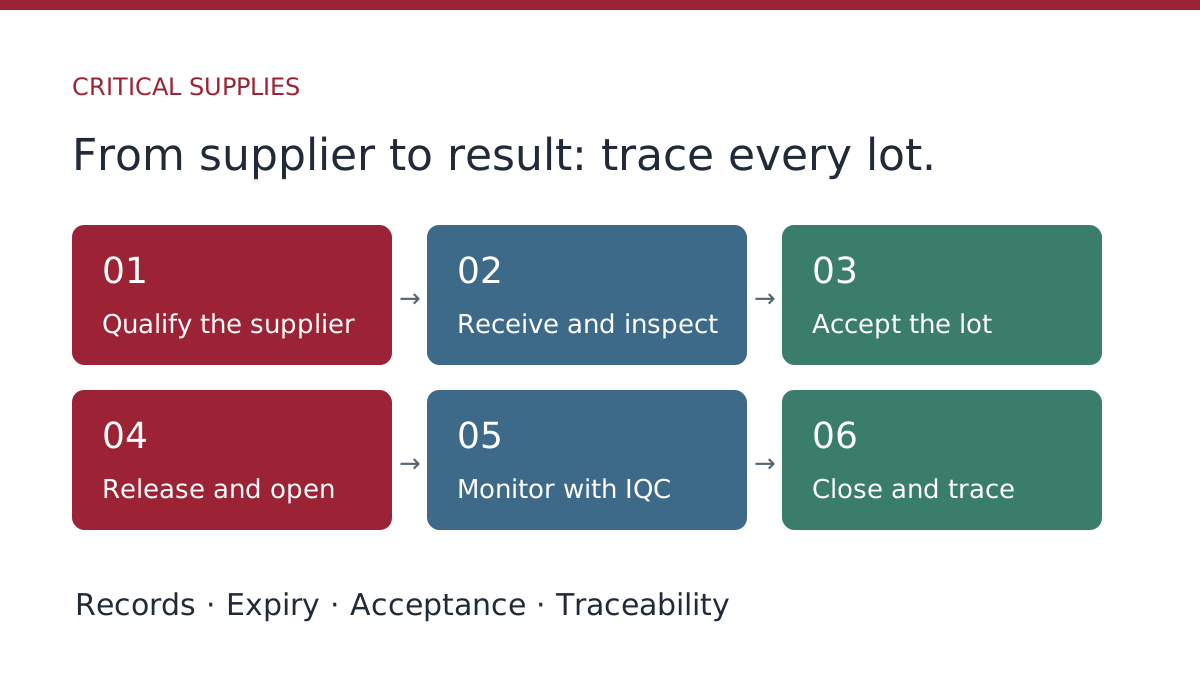
Think of a supply as a process with steps and evidence, not as an inventory item. Each step answers a question that an auditor, or your own team during an investigation, may ask.
- Qualify the supplier and record the product: who may supply it and what is the current specification?
- Receive and inspect: what arrived, in what condition and who checked it?
- Accept the lot: does the new lot produce results equivalent to the previous lot?
- Release and open: when did use begin and what is the in-use expiry after opening?
- Monitor with IQC: did performance change after the switch?
- Close and trace: when was the lot withdrawn, why, and which runs did it reach?
A rejected, suspended or recalled lot leaves the flow at any point. The record must show the block and remain available for the retention period.
4. Suppliers and product records
For suppliers of consumables, RDC 978/2025 does not require a written contract: invoices and equivalent documents prove the purchase. That does not waive qualification. Where applicable, the laboratory must request proof of regulatory compliance, and both parties must ensure the products are fit for purpose. [1]
Define objective criteria and record every evaluation: product and establishment authorization, quality system, technical documentation, cold-chain transport, delivery time and support. ISO 15189:2022 asks for qualification, selection, performance evaluation and re-evaluation criteria, with records of the resulting actions. [7]
| Status | In practice |
|---|---|
| Approved | May supply until the next re-evaluation date. |
| Conditionally approved | May supply under a described additional control, such as a temperature check at every receipt. |
| Evaluation expired | Re-evaluate before accepting new deliveries. |
| Disqualified | New purchases suspended until requalification. |
In the product record, register the regulatory authorization number and its expiry, the current version of the instructions for use, the measuring range of each analyte, the storage conditions and whether the lot requires acceptance before use. Keep versions: an older result must stay linked to the specification in force when it was issued. In Brazil, RDC 830/2023 covers the risk classification and authorization of these products. [2]
5. Receipt, storage and expiry
At receipt, record the product, lot, shipment, expiry date, quantity, invoice, transport temperature, packaging integrity and who checked it. RDC 978/2025 explicitly mentions the lot number, compliance of transport conditions and the receipt date. [1]
Keep lots that are not yet accepted, released lots and rejected or expired lots physically and documentarily separate. A shipment that arrived with a temperature excursion must stay in quarantine until it is evaluated. ISO 15189:2022 and the WHO quality management handbook describe this segregation and inventory control. [7][8]
Store products in temperature-monitored equipment compatible with the range stated by the manufacturer. When refrigeration is used, record the maximum, minimum and current temperatures, and plan how to preserve products during a power failure. [1]
There are two expiry dates. The manufacturer's applies to the unopened product. In-use stability starts when the product is opened or reconstituted and is usually shorter. Use whichever ends first. Once expired, RDC 978/2025 prohibits re-dating the product. [1]
For reagents prepared or aliquoted in the laboratory, the label must show name, concentration, lot, preparation date, person responsible, expiry, storage conditions and hazards. These preparations may not be sold or exchanged with other services. [1]
6. Accepting a new lot or shipment
Different lots of the same reagent or calibrator can produce different results, and the effect can be clinically relevant even when the control stays within limits. The literature documents cases in which the change only appeared in patient results. [10]
The CLSI EP26 protocol guides the user evaluation: define the acceptance criterion before measuring, choose the number of samples based on that criterion and compare the current and new lots under the same conditions. [9]
Which samples to use
Prefer patient samples that cover the range of interest. Control materials may not be commutable: they can respond to a lot change differently from real samples and hide or exaggerate the difference. Use controls as a complement or when patient samples are not feasible, and record that limitation. [10]
How to decide
Choose the criterion before testing and record its source: a fraction of the total allowable error, the manufacturer's specification or another documented criterion. Calculate the difference for each pair, the mean difference and the dispersion. If the result does not meet the criterion, the lot is not used until there is a documented decision.
Difference (%) = 100 × (result with the new lot − result with the current lot) ÷ result with the current lot
| Sample | Current lot (mg/dL) | New lot (mg/dL) | Difference |
|---|---|---|---|
| Patient 1 | 92,0 | 93,1 | +1,20% |
| Patient 2 | 126,0 | 127,9 | +1,51% |
| Patient 3 | 184,0 | 186,2 | +1,20% |
| Patient 4 | 248,0 | 251,0 | +1,21% |
| Patient 5 | 312,0 | 315,9 | +1,25% |
The mean difference is +1.27%, with a standard deviation of 0.13%. With a hypothetical criterion of 2.3%, one third of a 7% total allowable error, the lot passes. If the same comparison showed +6.5% in every sample, as in a shipment that suffered a temperature excursion, the lot would be rejected and segregated. The values are illustrative and do not recommend a criterion for any analyte.
Whenever possible, approval should be given by someone other than the person who performed the comparison. This segregation of duties is good management practice, not an explicit requirement of RDC 978/2025.
7. Lot changes in routine work and IQC
For single-use products, RDC 978/2025 requires IQC at least with every new lot, every shipment and as the manufacturer instructs. This frequency can only be reduced with technical criteria, initial training provided by the supplier and certificates from lot-by-lot certification programs run by accredited laboratories, kept available to the health authority. [1]
- Declare when the new lot starts being used, with date, time, affected controls and person responsible. Without this record you cannot separate before from after.
- Follow the instructions for use regarding calibration: many manufacturers require calibration or calibration verification when the reagent lot changes. Record the evidence.
- Do not recalculate the control mean and standard deviation just because the reagent changed. The limits represent expected performance; a lot change that shifts the control is exactly what IQC must reveal.
- If the limits need revising, do it formally, with the reason, statistical data, person responsible and approver.
- Follow the first runs after the switch: compare the observed mean with the target and investigate shifts, even if no Westgard rule was violated.
- Do not mix components from different lots of the same kit unless the manufacturer allows it. [5]
A reagent lot change is different from a control material lot change. In the second case, the laboratory establishes the mean and standard deviation of the new material; in the first, the control material is the tool that reveals the effect of the new reagent. [6]
8. Incidents, recalls and traceability
In Brazil, technical complaints and adverse events associated with regulated products must be reported in Notivisa. The laboratory must also investigate the occurrence, take measures to prevent recurrence and cooperate with field actions, which are the responsibility of the manufacturer or registration holder. [1][3][4]
When a manufacturer recalls a lot, the immediate question is: which runs and which results used that lot? Answering requires each run to have its lot recorded at the time of analysis, not reconstructed later from the team's memory. With that link, the laboratory defines the period, evaluates the potentially affected results and documents the decision.
- Suspend use and segregate the lot.
- Record the incident with a description, the notice reference, the action taken and the person responsible.
- Identify the runs and controls that used the lot.
- Report where applicable and follow the field action to completion.
- Declare the replacement lot before resuming routine work.
Keep all these records for the minimum of 5 years required by RDC 978/2025. [1]
9. Indicators and periodic review
Indicators turn records into management decisions. Review them in the periodic IQC review and when re-evaluating suppliers.
| Indicator | What it shows |
|---|---|
| Nonconforming receipts by supplier | Transport, packaging or documentation problems. |
| Lots rejected at acceptance | Lot-to-lot variability of the product or storage failures. |
| Incidents and recalls | Product reliability and speed of response. |
| IQC nonconformities close to lot changes | Where to investigate first; correlation does not prove causation. |
| Within-lot and between-lot imprecision | How much lot changes contribute to the control's total variation. |
Interpret the proportion of nonconformities associated with lot changes with caution: it depends on how many changes occurred and on the period. Use it to prioritize investigations, not to rank suppliers without analysis.
10. How QualiChart supports this control
| Step | In QualiChart |
|---|---|
| Suppliers | Records with initial, periodic and extraordinary evaluations, criteria and current status; receipts require a supplier approved on that date. |
| Products | Versions with regulatory authorization, instructions for use, measuring range and method per analyte, and storage conditions. |
| Receipt | Lot, shipment, expiry, invoice, transport temperature, condition, UDI code reading and compatible storage equipment, integrated with temperature control. |
| Acceptance | Paired results, a recorded criterion, calculated mean difference and approval by another user; waivers only with justification. |
| Opening and closing | Configurable checklists and in-use expiry calculated from opening. |
| Use in IQC | Declaration of the lot in use per control; every run records the lot automatically, including imports; expired, suspended or recalled lots are blocked. |
| Monitoring | Changes marked on the Levey-Jennings chart, pending calibration verification, post-change shift assessment and within-lot and between-lot imprecision. |
| Investigation | Westgard violations close to a change suggest the cause in the critical review, which the team confirms or replaces. |
| Incidents and traceability | Incidents, recalls and field actions suspend the lot; traceability lists the runs that used each lot; reports gather the evidence. |
On the control panel, the focus remains IQC. Supply data sits on a dedicated screen for each control, reached through a link that flags when something needs checking.
To see the workflow with your laboratory's data, request a demo.
11. Implementation roadmap for the laboratory
- List critical supplies by test and instrument, starting with the highest-risk ones.
- Define qualification criteria and evaluate current suppliers.
- Standardize receipt records and the segregation of lots not yet accepted.
- Write the acceptance protocol: samples, number of pairs, criterion and approver.
- Record when each lot starts and stops being used and link it to the runs.
- Establish the response to incidents and recalls, including reporting.
- Review indicators and suppliers periodically and keep records for 5 years.
To explore related topics, see also:
12. Frequently asked questions
Do I need a patient-sample acceptance for every lot change?
RDC 978/2025 requires IQC with every lot and shipment change for single-use products; it does not prescribe a patient comparison protocol. The comparison is good practice recommended by the literature and by CLSI EP26, with an effort proportional to the test's risk and its history of lot-to-lot variation.
Can I use an expired reagent if the control is acceptable?
No. RDC 978/2025 prohibits re-dating after expiry, and CLIA prohibits the use of expired reagents. An acceptable control does not replace the manufacturer's guarantee.
Does a lot certificate exempt the lot change from IQC?
Not automatically. It is one of the conditions for reducing the frequency, together with technical criteria, ensuring the IQC objective is met and initial training provided by the supplier.
Does a supplier of consumables need a written contract?
RDC 978/2025 waives the written contract for suppliers of consumables, accepting invoices and equivalent documents. Supplier qualification and verification of regulatory compliance remain necessary.
References used
Sources consulted on September 26, 2026. Numerical examples and roadmaps are for teaching. For the ISO and CLSI standards, the public description of the content was consulted; full application requires access to the corresponding document.
- ANVISA (Brazil). Resolution RDC No. 978 of June 6, 2025. Services that perform clinical laboratory tests. In Portuguese.
- ANVISA (Brazil). Resolution RDC No. 830 of December 6, 2023. In vitro diagnostic medical devices. In Portuguese.
- ANVISA (Brazil). Resolution RDC No. 67 of December 21, 2009. Technovigilance. In Portuguese.
- ANVISA (Brazil). Resolution RDC No. 551 of August 30, 2021. Field actions for medical devices. In Portuguese.
- HHS/CMS. 42 CFR §493.1252 — Test systems, equipment, instruments, reagents, materials, and supplies (CLIA).
- HHS/CMS. 42 CFR §493.1256 — Control procedures (CLIA).
- ISO 15189:2022. Medical laboratories — Requirements for quality and competence. Clauses 6.6 and 6.8.
- World Health Organization. Laboratory quality management system: handbook. 2011.
- CLSI. EP26: User Evaluation of Acceptability of a Reagent Lot Change.
- Thompson S, Chesher D. Lot-to-lot variation. Clin Biochem Rev. 2018;39(2):51–60.